
Kiran Bhaskaran, Chief Consultant, Indian Farm School, Bangalore, shares his views on how school gardens are a fun and practical way to teach students about health and the environment. By planting and caring for gardens, children learn about nutritious food, healthy habits, and practices. They also gain awareness of climate change and how their actions can help protect the planet. These experiences make learning interactive, meaningful, and enjoyable for students.
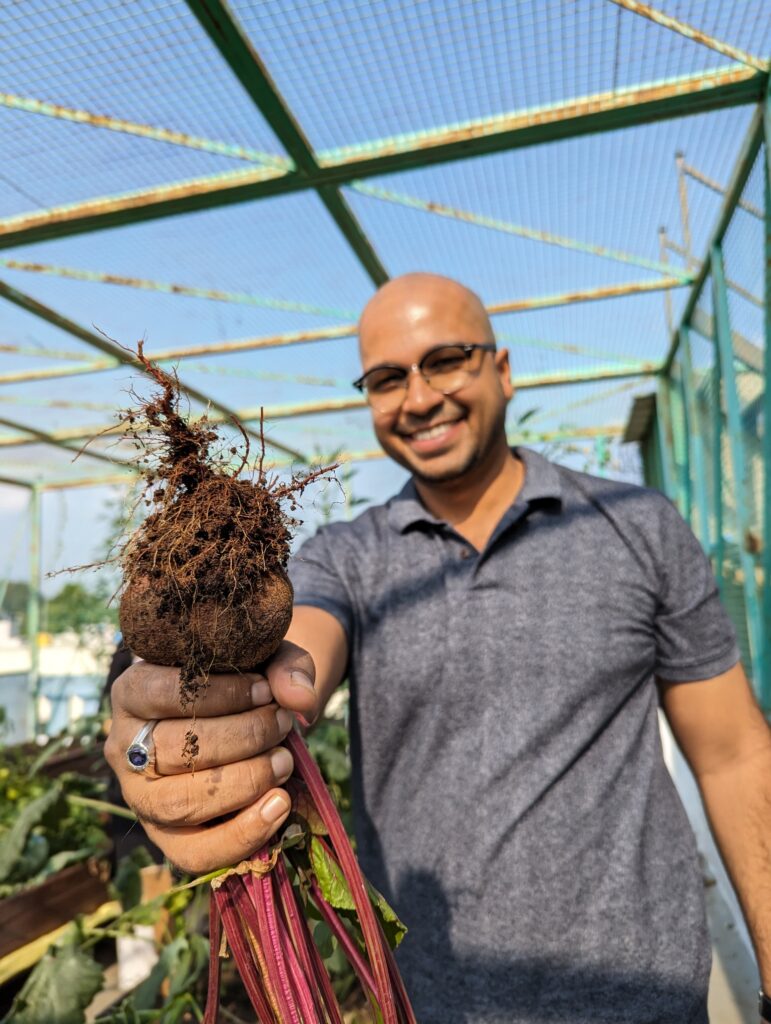
I am the founder and chief consultant of Indian Farm School, an organic agriculture consultancy, training, and school gardening organisation. We promote a sustainable way of living and farming through school gardening projects across India. Our team visits schools, helps them set up organic gardens on their premises, and teaches children how to grow vegetables. Despite limited space and resources, students can develop organic gardens that provide them with healthy and nutritious produce.
Throughout the year, our small team visits schools to educate children about organic gardening. They learn how to care for plants, manage pests and diseases organically, harvest the produce, and share it with others.
Quite often, we find that children are not very receptive in classroom settings. But when we take them to the garden, their learning transforms, and it has a unique impact. At one school, for instance, we created a terrace garden using discarded packaging wood sourced from the market to build vegetable beds. We guided the children in mixing potting materials like cocopeat, soil, and compost, and they filled the beds themselves.
It was a natural way of developing a terrace garden, without using any advanced tools. The children even produced compost using locally available resources. We made vegetable beds measuring 2.5 feet in width and 4 feet in length, providing about 10 sq. ft. of cultivation space per bed. Some beds were made taller for certain crops, while others were shallower. We grew carrots, radish, and beetroot — vegetables commonly consumed in households- to help children understand how to manage different crops within a small area.
The kitchen garden model follows a similar approach. We turn soil into raised vegetable beds to grow crops. Some schools have ample space, so we recommend developing gardens directly on the ground. However, in urban areas where space is limited, we introduced the kitchen garden model for terraces. In these gardens, we grow spinach, exotic vegetables, kale, beans, lady’s fingers (okra), and more — all within compact spaces.
Lessons in the garden
Both the terrace and kitchen garden concepts are nearly identical in structure. Once the setup is complete, the teaching process for organic vegetable gardening remains the same. We typically create groups of around eight children. If there are more beds, we conduct batches per vegetable crop cycle, which usually ranges from 45 to 90 days. As the garden expands, we can engage three to four classes at a time, assigning dedicated spaces for each group.
We begin by teaching the fundamentals of gardening — the essential components, awareness of soil ingredients, and the preparation of the potting mix. Students learn what is needed to maintain a successful organic or kitchen garden, whether at home or in school. Once they grasp the basics, we move on to seeding various vegetables. Seeds are sourced from organic farmers or seed banks and are either sown directly into the soil or started in nursery trays. Root crops, in particular, are sown directly in the beds. Each team is given a specific bed or growing space to manage, and they take full responsibility for it — from spacing and pest management to nurturing what they’ve sown, guided by the knowledge gained from our sessions.
Our resource persons visit the schools weekly and conduct classes that last between 40 minutes and 1.5 hours. During these sessions, students gain hands-on knowledge of seeding, composting, and pest and disease control. They are also introduced to the principles of sustainability — including efficient watering practices, garden management, and contributing to ecosystem preservation by not harming nature.
Indian Farm School has developed a year-round curriculum for students, covering how to create and care for a garden at school or home, grow vegetables successfully, and navigate challenges that arise during cultivation. By the end of the year, students feel confident in setting up and maintaining their own organic gardens.
As seeds sprout, we teach children about weeding and thinning. Often, too many seedlings germinate close together, which hinders growth. We guide them to retain the healthiest plants, ensuring each one has enough space. Through this, students gain practical experience in managing real-life gardening challenges. For instance, if they overwater the plants, they notice wilting or stunted growth. They observe how yellowing or weak plants result from improper watering — and learn from it quickly.
Our gardening educators are well-trained professionals who also possess strong teaching skills, ensuring that every class is both informative and inspiring.
Learning to grow, growing to learn
Many of the crops we grow are indigenous and often unfamiliar to children. But through hands-on experience, they start developing an affinity for these vegetables — even for the ones they may have previously disliked or wasted. When they finally harvest and hold the vegetables in their hands, there’s a spark of excitement. They’re eager to taste them, experiment with new dishes, and discover flavours they never thought they’d enjoy.
They also learn how to stagger harvests over several weeks — spinach, fenugreek, cabbage, cauliflower, brinjal, tomato, radish — each crop offering its own unique learning curve. With every season, they harvest different vegetables and experience firsthand how nature changes the rhythm of their garden.
When young children with limited knowledge can successfully grow vegetables, it really drives home a powerful message — if they can do it, adults certainly can too. The children often use their produce for potlucks, take vegetables home to cook, or share the dishes they’ve made with others. Through this, they come to understand the challenges, processes, and joys of growing their own food — and most importantly, the value of giving back to society.
Once the harvest is complete, they move on to a new crop cycle and typically manage three to four cycles in a year. Quite often, the children choose to donate part of their harvest to orphanages or old-age homes, where there’s always a need for fresh vegetables. It gives them immense satisfaction to share the fruits of their labour — quite literally.
Educating for a greener future
Our focus is on instilling what I call an education of realisation. When there’s heavy rain and crops are lost, children experience firsthand how easily natural patterns can be disturbed — and the consequences that follow. Through such experiences, they begin to understand the importance of respecting nature and adopting practices that help preserve it.
I remember visiting one of our early project schools and asking the children what they had learned from their organic garden. Their answers were remarkable: they spoke about addressing climate change, avoiding chemicals, enriching soil with organic carbon, understanding the greenhouse effect, and conserving water by growing indigenous crops. Though we primarily taught them vegetable gardening and simple precautions, they went a step further. On their own, they researched how organic gardening supports the environment. What we’re really doing is sowing seeds of curiosity — curiosity that deepens their realisation of nature’s true value.
We also make it a point to involve parents during some of our seeding sessions. They join the children in sowing seeds, mixing compost, and setting up the garden. It turns into a community activity. Parents learn alongside their children, who are always excited to share their gardening stories at home. You can see the pride on their faces. At times, we also invite teachers, village leaders, farmers, and local community members to visit and observe the gardens. Their appreciation further reinforces the importance of sustainability and respect for food.
Since the pandemic, society has become more health-conscious — and that awareness has only strengthened our resolve to improve lives through these gardens. Today’s children are tomorrow’s parents; they will carry these values forward and pass them on to future generations. Our goal is to nurture young influencers — children who advocate for sustainability in their homes and communities. Even with limited resources, we teach them to be grateful and respectful towards nature.
Beyond schools, we also cultivate gardens in orphanages and old-age homes, supported by CSR funds. These institutions need fresh vegetables every day. We train residents to manage the gardens and gradually hand over full responsibility to them. They become the caretakers — true custodians of the garden — who take initiative, create productive spaces, and overcome challenges with guidance from our team.
These are the two models we’re currently working on — empowering schools and care institutions to build a culture of sustainability through organic gardening.
This is a summary of the talk given by the author on schoolreformer.com
Contact details
Kiran Bhaskaran
Founder & Chief Consultant
Indian Farm School
Email: kiran@indianfarmschool.com
Website: www.indianfarmschool.com
Mob: +91 6361290954