
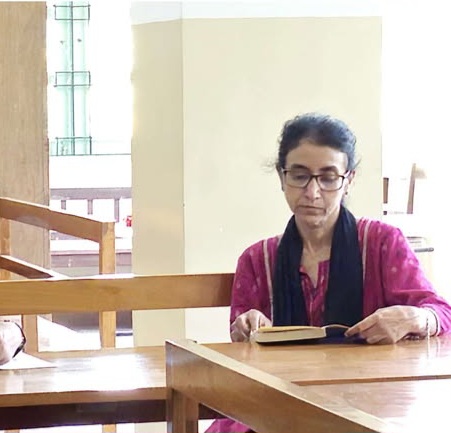
Ahana Mitra is a biology teacher in Carmel Convent School, Durgapur, who talks about why STEM (Science, Technology, Engineering, and Maths) is important in today’s education. She explains how it helps students think better, be creative, and become leaders. She also shares how teachers can use simple, everyday things to make STEM fun and easy for everyone to learn.
The world our children are stepping into demands more than memorised facts — it demands thinkers, innovators, and problem-solvers. STEM education blends Science, Technology, Engineering, and Mathematics into real-world learning that sparks curiosity and creativity. When we introduce STEM early, we give students the confidence to question, explore, and build solutions for tomorrow’s challenges. This article discusses how, as parents and teachers, we have the power to ignite this spark and shape a generation ready to lead.
STEM, the modern curriculum, is not a new concept, as it has existed since 2006 in various parts of the world. Now it is unfolding in India. I would like to explain the scopes and how we, as educators, can use them to cater to 21st-century students with the required skills right from the beginning, as education is undergoing tremendous changes in the course of time. We have shifted to online mode post-COVID apart from homeschooling.
To define STEM, it is an interdisciplinary approach to learning Science, Technology, Math, and Engineering to develop critical thinking skills, problem-solving abilities, analytical thinking, etc. These are the 21st-century skills expected of the students. Analytical thinking is the processing of the data, of getting the input of correct data received, and accordingly, the students have to identify, understand the problems, and get correct information to arrive at possible solutions. Many solutions may not work, and so they have to find the best-suited solution for the problem. This is how analytical thinking and innovation happen for a given problem through learning STEM. Active learning comes in to bring in critical thinking and creativity in students, which is the need of the hour, and thus bring out the leadership qualities in them so that they can be good social influencers.
STEM was introduced in 2001 by the National Science Foundation, USA, and the name was given by American biologist J. Ramale to mean the integration of all technologies. Under Science, we have biochemistry, biophysics, environmental science, hydrology, geoscience, medicine, etc. When we come to the Technology aspect of STEM, we have computer science, industrial design, and information technology. Under E of STEM, Engineering, we have biomedical, aerospace, and electrical engineering subjects, with more subjects coming up. We have Math, where we have applied mathematics, data science, and statistics.
NEP 2020 is already creating a new trend in the educational system in India. STEM focuses on competency and a shift from traditional teaching methods, and online methodologies are being used. We give more importance to a competency-based curriculum, which will be a shift from traditional teaching methods. We have homeschools and online teaching methodologies that are being used. We find education nowadays as more interactive and holistic to help students cope with future challenges and develop problem-solving skills. We can get the knowledge in a passive way, in a more interactive and holistic method. This will make the students face their future challenges with better vision and clarity of thought. So, we can start STEM right from the Montessori level, develop observational skills, and give them small challenges to solve by brainstorming. According to the grade, we can check their observational skills and give them small projects. Plenty of job opportunities are available for STEM degree holders across the globe. The Government of India has come up with ATAL Tinkering Lab to create an environment of scientific temperament, creativity, and innovation. We also have SETU (Self-Employment and Talent Utilisation) and Digital India Mission, which work on improving internet connectivity, especially in rural areas, to improve online learning resources. Skill India Mission helps students with vocational training to develop technical skills. Many scholarships are being offered by the government so that more students can be familiarised with STEM education. There are tie-ups with institutions that specialise in robotics and AI, and the Government of India wants everyone to get familiarised with these through STEM education.
Challenges facing educators
There are, of course, a few challenges in imparting STEM education. First is the lack of resources, but I feel we can use our resources, such as things used in our daily lives. We can use them to develop thinking and problem-solving skills, and creativity among students. For example, when we discuss atmospheric pressure in lower classes, we can use straws, which can be found in our daily lives, to learn about atmospheric pressure. We have to be innovative and find methods of trying various activities to engage the students. We can ask them to use the straws to build geodesic domes or use some other resource to build a tower. This will enable the students to learn not only science but also technologies such as cutting and measuring. They will also start appreciating math as they will be calculating and using data for their learning. As students move to higher classes, in more effective ways, we can shift to assessments. We can create groups and give assignments, starting with simple ones. If we ask them to finish it in one day, they will be more interactive and learn the subjects better. We can give them smaller assignments. We, teachers, have to be more innovative to infuse enthusiasm in them and make them correlate things they learn in class with the outside world. As they progress further in their studies, they will find careers in data science, analytics, cybersecurity, biotechnology, and AI tools. All of us are aware of ethical hackers, who have a huge scope in the technology field now. Now, we are slowly shifting from STEM to STEAM with the introduction of arts subjects to the rest of the subjects, so that the students can engage and contribute better. This will help the future generation to be better equipped with presentation capabilities and present their projects appealingly. They should be able to express their thoughts using good language for speaking, writing, and crafting parts to integrate science with the arts subjects. For example, if the students are working on a project on “Pyramids of Egypt,” it involves both aspects of mathematics (angles of inclination) and science ( preservation techniques of dead bodies), and they also learn to appreciate the artistic features of pyramids. Thus, we can incorporate art subjects in STEM education successfully.
Overcoming challenges in STEM education
Mainly, the infrastructure and mindset are the biggest challenges. We are aware now that group teaching has to be done. Before 2020, the teachers had to focus on what the curriculum demanded, and the students were used to the exam and grading system. But now it is all changing. The mindset of parents, parents, and peers, even now, is a challenge. There is gender disparity. They feel science and technology are best suited for male students, and girls can opt for biology and the arts. We have to work on these beliefs at the primary level. Next are resources. We should teach our children to use the resources available around them. We have to share motivational stories, such as how astronauts used the resources available to them to return safely to the earth when Apollo 13 exploded, and they will develop such a positive mindset. As of now, we are practising all these things up to a certain level only, and after that, it is all lost. The implementation is not at its fullest. So, when the students enter the workspaces, they have to learn problem-solving and analytical thinking skills again. I would say there should be no gap in STEM training. The teachers should also be trained to access resources to upgrade themselves. As facilitators of learning, it is important to upgrade ourselves. We need more institutions to impart training to teachers so that when they go back to schools, they can offer activity-based STEM teaching to the Indian students, so that they are not left out in the global scenario.
Using existing resources
Yes, we need to put more stress on activities. Often, the schools feel that when the students indulge in activities, they may not focus on studies. But with access to digital formats, they learn better and can be engaged better in learning. When I asked my Biology students to make a solar cooker, they were very excited. I just suggested they could use trash boxes. These are such small things we use in our daily lives, and can be used effectively. When they started using them for their project, they learned how to do it, which should be the reflecting surface, the angle of reflection, which are all part of science. They also learned to communicate well. In this way, we can also integrate the arts into science. We have to give students such small assignments. Not all schools will have Tinker labs or costly robotic setups. We have to start at the basic level in our schools, where the students come every day to learn. We have to encourage their exploring mind and observation skills, which will take them high in the next stage of their lives.
To conclude, I am very hopeful about seeing a big transformation in the education system through the STEM curriculum.
This is a summary of the talk given by the author on schoolreformer.com
Contact details
Ahana Mitra
Biology Educator, Carmel Convent School, Durgapur
M:89817 27226
Email:pixieaha@gmail.com