
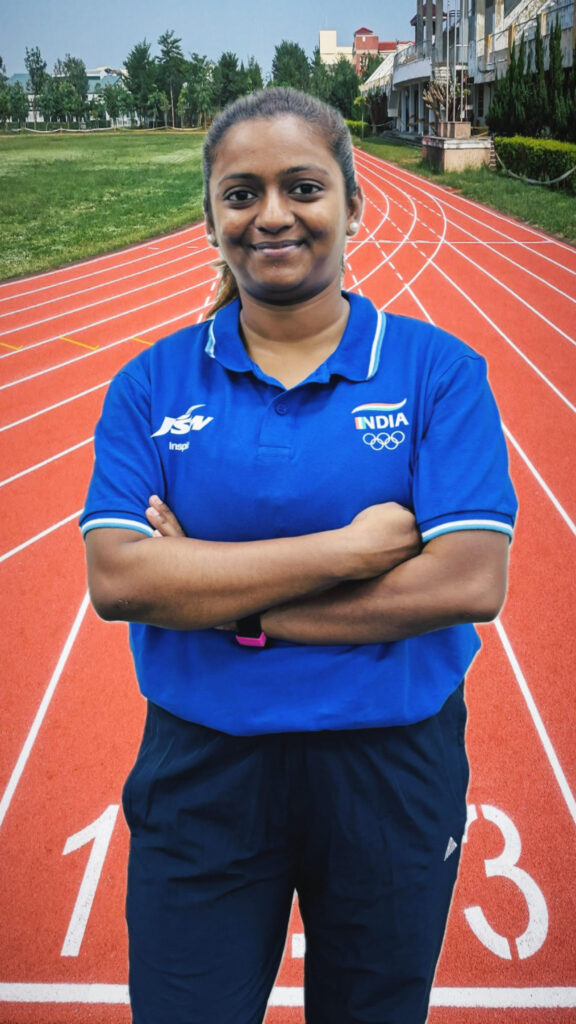
Dhanlaxmi Krishnan, Physical education teacher, describes how athletics and education go hand in hand in shaping a student’s future. Sports not only build physical fitness but also teach discipline, teamwork, goal-setting, and leadership—skills that support academic success. By combining visible thinking routines with training, educators can track progress, boost engagement, and help students grow holistically. The speaker explains how athletics develops qualities that last a lifetime, benefiting both the classroom and the field.
As a physical education teacher and track and field coach, I would like to discuss how athletics and education can be combined for a bright future for a student. It is essential to use a lot of visible thinking routines for the students in the school, as it can help us to understand the success criteria of the journey in sports. Bridging athletics and education can help us become better educators, as we can understand the students’ connection to track and field and how education and sports go hand in hand. We should know how athletics can help in developing an athlete and also educating them. We should know how to boost students’ engagement and what it means to develop a student holistically. We always think that athletics is all about physical activity, but there is more to it. It helps in building qualities in an athlete; he realizes how to be goal-oriented, disciplined, and consistent in performances.
A child has to be goal-oriented and needs discipline. In India, we cannot depend only on sports or only on education. The students should also have good co-curricular qualities. In athletics, there are a couple of principles that are important for educators and students to know, the pathway to follow. Goal setting and progress tracking do not apply only in sports but also in education. Educators have certain goals with learners in focus. In athletics, we have clear and measurable goals. For example, if I need to improve my sprint time, it is a clear goal for me as an athlete. Similarly, a student may feel he should score well in specific subjects. In this way, goals are connected to different areas. We, as educators, need to help the students set academic and personal learning goals, and we need to track their progress in due course. During a parent-teacher meeting, we give feedback to the parents about the progress of their child and also where he is lagging. This helps the parents, teachers, and students understand the progress of the student and what we should do to help them improve.
Children usually move from place to place, and in sports, we set personal bests depending on their previous records. In this way, they know their timing, understand where they stand, and their current status. I always ask my athletes to maintain a book where they record their achievements, their jumps, throws, and timing. When they compare themselves with any upcoming event, they will have the data to work more on. Even coaches have progress reports that help them to know where the children stand. When I tell my athletes to set SMART goals.
SMART moves, bright minds
The word SMART is an abbreviation. S stands for specific, M for measurable, A for achievable, R for relevant, and T for time-bound. Smart goals have a clear-cut answer for questions such as who, what, when, and where. It is a very specific and clear goal, and the student should be able to define the goals very clearly to get good grades. In education, when the student improves on a particular subject by practising regularly, we can find consistency in their performance. In athletics, we need to be clear about drills, such as jumping, throwing, and running.
M stands for measurable, both in track and field, and about measurement in sports and athletics. It is about the distance the student has covered in shotput, jumped in the long jump, and how fast he has run the race. These measurements help us track progress. The child works hard and trains to achieve the target. So the goal should be measurable for the progress to be tracked. It is not necessary that each time the child has to keep progressing. The child can also be in a plateau stage by repeating the same measurements. It can happen at times. The child can be advised that he needs to work hard to get out of the plateau stage and move forward. We can help the child progress when we know the goal clearly.
A stands for achievable, which is very important and realistic. Within a short time of our joining the school, if we want to reach the pinnacle, it will not be possible. We have to set achievable goals and stay focused in practice. The goals have to be realistic. Often, we have heard parents saying their children have been practising for a few years now, but they are not getting any medals. But there are many reasons for this. Sleep cycle, water intake, and diet are taken into account. The routine of the child also matters a lot. The goals can be minimal but achievable. The child should realise he is progressing slowly but steadily. I tell my athletes to have simple goals, be clear, and focus on high-impact targets that can be easily tracked. The goals have to match personal and professional objectives. It has to help in building confidence, skills, and the ability to achieve. We have to jot down the SMART goals and achieve them in a short duration. Performance improvement will help us understand the specific goals and start believing in ourselves. Athletics is all about teamwork, motivation, and kinaesthetic learning. When we give group engagements, we can observe a lot of peer discussion with risk-takers, and different dynamic people coming together, and the development is wonderful. They understand each other’s strengths and weaknesses. This helps the child to be part of the group and share the responsibility through communication, supporting teammates, and working on strategies. The same pattern can be seen in the classroom, also. The child understands where he has gone wrong and how to do better. Challenges, leadership, and rewards motivate children. We have to give the feedback immediately to make them understand where they stand.
Active and kinaesthetic learning, and movement-based learning improve focus, memory, and energy levels. Some kids learn through movement as they cannot sit in one place for a long time. Role play, outdoor learning, and brain activities are incorporated. The overall development of a child comes from sports, dance, music, and art. Each child has different talents, and we have to identify the talent and bring in trans-disciplinary learning with them. There comes holistic development. Not every child can have leadership qualities and take up responsible roles. But we have to give such responsibility to them, have a good discussion, and take action. When the real opportunity is given to a child to develop leadership skills, resilience, and stress management, he picks up such qualities so easily.
Sports are all about being sincere, punctual, organised, respectful, and strategic. A sportsperson learns to show fairness, respect, understanding, and discipline. This is a lifelong learning experience, and the child builds qualities that will help in education and sports equally. We have to make them understand real-life situations and reach a high level of achievement. Sports and arts can make a child feel brave and confident. As educators, we can develop strategies for the holistic development of students.
Exams and exercise balance
When the students have to travel from place to place for a long time, parents feel that time has to be saved. So I suggest simple home workouts for them for 25 minutes, which they can do on their own. The children can do the workouts in their place, at their time, and space. When the child says that he cannot make it, and parents say that they cannot travel during exam time, I give them homework to do at home, things that they can manage. It will encourage them to be fit and develop confidence in the coach. They will think that even if they do not go to the ground, they can do some exercises by themselves at home.
From reluctance to leadership
I have faced a similar experience. Not all the children who come to sports training are interested in the field. There are some who like sports and some who do not. So, as a coach, I give them two options. In the first 20 minutes, they have to follow what activities I suggest to them. For the next 20 minutes, they can do activities of their choice. Then gradually the teaching time increases to 30 minutes, and the time they spend doing activities of their choice reduces. During the time that I have with them, I teach them how to start running, swing their hands, and lift their legs. The children have fun and become competitive. I give them different roles and make the disinterested children leaders. We can see the joy on their faces. We can make them understand the importance of sports and warm-up. For example, in the case of football, the players have to do a warm-up. Once they know the importance and value of this, they will not refuse to do it. When we make them leaders, they will realise they have to be responsible. They will want to be role models. We can motivate them when they follow rules, become good leaders, and develop leadership skills. Usually, I give three smileys to the class – big, normal, and sad smileys. We can tap the appropriate one when we leave the class to let them know how the session was. Everybody has preferences. When the kids come to our class, we have to give them a chance to be a leader. We have to make them realise the value of a warm-up. They can avoid injuries. Such small steps can help us handle situations. I have different strategies that can be used for the students.
This is a summary of the talk given by the author on schoolreformer.com
Contact details:
Dhanlaxmi Krishnan
Physical Education Teacher & Track & Field Coach
E: Krishnandhanlaxmi@gmail.com
M: 9987215474