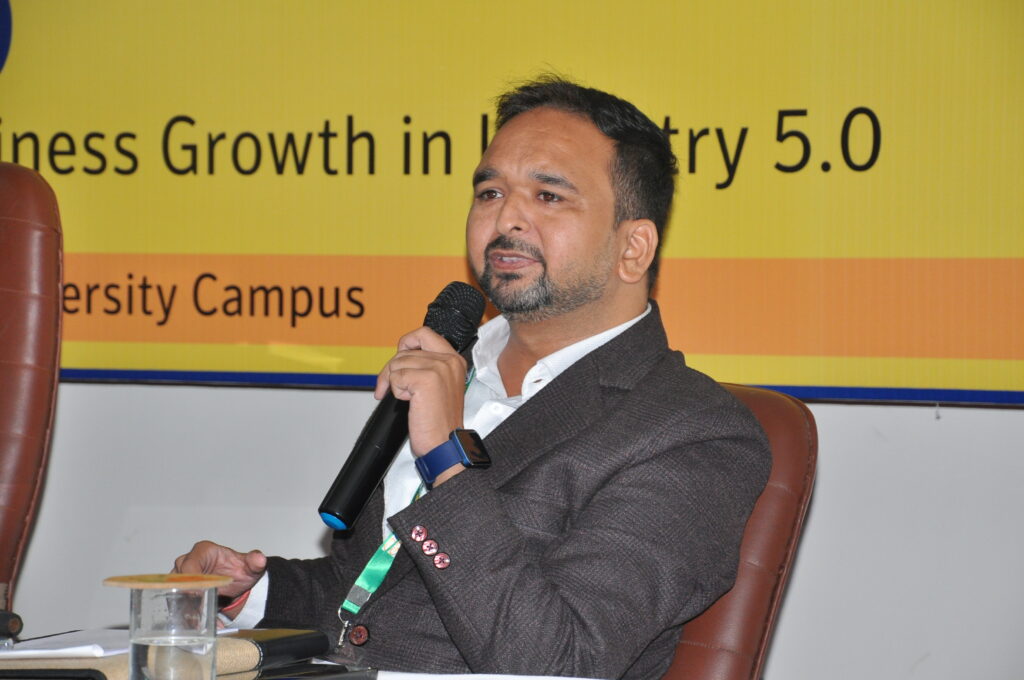
Amit Dubey, Business Strategies Director, Vectors Group, Ottawa, Ontario, Canada, explains how everyone has unique talents and interests, and the challenge is to understand how to use them in the right way. Knowing our purpose helps us connect our skills with real-world needs. It allows us to build a life that feels meaningful and rewarding.
Ikigai is a Japanese term referring to something that one feels is the meaning of one’s life. The idea of finding a person’s purpose in life is very important for youth since they have the energy, but it is missing from all of them. Finding a purpose in life is not very easy. To be very frank, it is not the kind of thing that we can search on Google, on the internet, or ask AI.
The delegation session in Mumbai, where I could read the book on Ikigai, transformed me. Then I realised that I was not doing the things that I loved to do. It was in 2017 that my life’s purpose changed totally. I have started feeling that money is not everything now; every day dawns with a new purpose. I start the day to find awareness and execute the same. I ask my family, friends, and mentor questions about it. It is not done in a single day, but it keeps going on for days. I realised that Ikigai is the purpose of my life, and then I started connecting with people and empowering youth.
Since I have mentored more than 2,000 students until now and helped them in their careers, let me tell you what the process is, and what the fundamentals are that you can utilise. It is totally up to you whether you would like to become one. So the basic fundamental of finding a purpose starts with one thing: connect the dots, identify your purpose. Discovering your purpose again is a long process. So the first thing you need to understand, irrespective of what you are doing, be it education, looking for a job or a person who is really eager to build themselves and their career as well. You have to start with the first dot, and the first dot could be to know what you love to do, what your passion is, what things make you do and add value to your life. By the end of the day, you will get some answers; you will get some clues on where you would like to find out. You have to answer these questions, and these questions will show you the direction of your life or the purpose of your life.
Start with what you love to do, including what you are good at and the world’s needs, apart from the biggest problem faced by millions and billions of people. I usually say my quote during my talk, “Either you solve a problem worth 1 million, or you solve 1 million problems worth one rupee or $1, you will be the next millionaire”. The problem statement you are solving with that one purpose, and if you find that and work on it, it will help you to find the purpose of your life.
There are four dots to connect, which you need to understand. Before going to those four dots, we should know about Ikigai. Basically, Ikigai is a Japanese cultural concept of purpose. There is a book from Japan about the basic fundamentals of finding a purpose and why you are living your life. It starts with the first question: what do you love to do?
If I am asking what you love to do, it means the things that you love to do. If I am not giving you food for quite some time, what is the one thing you love to do? If I am not paying you, what is the one thing that you would love to do? If I am not pushing you for the same, what is the one thing? So that one activity helps you to understand what brings you joy and a sense of fulfilment. If you identify that one thing about your love, you start to connect.
So the first point is that you need to write the answer to your question on what is the one thing that I love to do. Many times when I meet youth and youngsters, I always ask why they are doing whatever they are doing. If someone says, “I am doing it for the sake of society, for the people who push me, for my parents,” and many more reasons. But when we ask, “Why are you doing this study? “ and the reply is “I don’t know”, if you do not know why you are doing this study or whatever you want to do, if you figure out that question, you connect faster.
The next point is what you are good at. For example, you love to do music, you love cooking, you love engineering as well, and if you have good skills or you are aware that you can hone your skills for that particular thing, it will help you to understand the direction. So you understand the first thought is that you love the thing, and second, you are good at it. You might be good at speaking, connecting with people, using technology, writing good code, or you could be an introvert or an extrovert. But the biggest challenge is that if you start to understand what you are good at, answer some questions, and you will figure out what your skills are.
The third dot, which is very important, is what the world needs. Let us start with the family, society, wherever you are living in your life. It could be in any corner of the world. Figure out one particular problem statement that you love, the one you are good at, and that everyone faces. Earlier, I was facing many challenges in finding a job and getting the right opportunity. I love to help people, youth, connect with people to transform and evolve their lives. I am good at speaking and at connecting with people. I know some fundamentals, a lot about human psychology, about how to speak with people and all these things. I practised it and understood the problem statement every young person in any country faces in their career. So I am trying to solve it with my mission of impacting 1 million youth in 2030.
One more thing is very important because we are all running day by day behind money. What can you be paid for? If you are good at something, have skills, and you have found the problem statement as well. But what if people are not able to understand or connect with the dots where they are ready to pay, your idea could go back again. So you need to find that kind of audience or those people who are ready to pay for the problem you are trying to solve.
Once you connect these four dots, you will be aware of the direction of your career, where you would like to become big in that particular field. I usually ask students, if parents allow them in a different field or stage, do you think they can become the greatest player or the greatest singer? Knowingly or unknowingly, people, their parents, and society know these four dots very well, and these four dots are available for everyone.
I do not believe that you have to go for a particular segment only. It is all about the fundamentals, basic ideology, what you love to do, what skills you have, what kind of people require the solution to the problem around you, and whether they are ready to pay for the same. Once you connect these four dots, it will help you to be aware of the direction your career could move.
You need to understand the basics, find what you are meant to do, what you love to do, the things you enjoy doing, which make you feel happy. Connecting with people or youth makes me happy. I am passionate about sharing the ideology of how to evolve new things. Think about what you enjoy during free time. What makes you smile and feel excited? Start to write it down. Once you write the answers in a notebook, you become aware of the direction in which you would like to go.
The next question is what you are good at. What do your best friends, teachers, society, and parents mention? They will compliment you for that particular skill. It could be speaking, connecting with people, writing code, or anything. Do you want to help others with the thing you are good at? When you answer these questions, it is another fundamental: what you love and what you are good at.
Now, the world’s needs. In what ways do you want to help to make a difference? Who do you want to help? What is the one problem statement that you love, which you are good at, and which you would like to solve in society, school, or your friend circle? It could be anything. If you are thinking about a bigger idea, like in terms of business or the start-up world, there are many ideas that work on these fundamentals. They love what they do, they figure out the skills, and they identify a big problem statement. But the question is, do you care about that problem?
Last but not least, what can you be paid for? Understand one thing: if they are not ready to pay, you will survive but not grow. If you are solving a problem statement and they are ready to pay 2,000 rupees because they know something about winning and can connect with that, and if they are ready to pay, your problem is solved. What could you charge for this? Have you helped someone with something useful? These are the questions you have to answer one by one. Write them down. Do not take help from ChatGPT. What is the one thing you enjoy? What is the one thing that makes you smile and feel excited? What are you good at? What do your friends praise you for? Who are the people you want to help? Finally, are they ready to pay? Do they have enough money to pay you for the problem statement you are going to solve?
Once you connect these four dots and write the answers, you become aware and start to create awareness in your career. This could be the basic formula. Understand something you enjoy. If I love to connect with people, and I polish that skill by reading books, articles, and podcasts, and I want to help people who are facing problems in building their careers, and I can earn money by mentoring, guiding, and coaching them, it helps me at the awareness level.
With this exercise, you may not immediately find the purpose of life. You may become aware of the direction to find the purpose of life because it takes multiple experiments and connections. The environment may change in five years, but you will still be aware. Once I got my Ikigai, it took me seven to eight years to transition from awareness to evolving every day, to connecting with people, to asking questions of my friends, society, and mentors, to realising my Ikigai, the purpose of my life. Balancing between the profit and non-profit sectors is very simple and basic, as I have to do the right thing at the right place. I devote my time during weekends to connect with people, to do something that is required, and during weekdays, I do my business. There is no hard and fast rule in my life. It depends on the schedule, what is required, the situation, and the time when I have to devote my attention. This is how I balance between the two.
For example, you might like drawing and be good at making posters. Now you can use Canva and other software. You might like teaching. You are good at English. You want to help younger students learn English through online tutorials. For a tech-loving student, if you like using computers, coding and similar things, and you are good at fixing phones, you can help people solve tech problems. Technology is a very big industry as well.
If you start connecting the Four dots, create awareness, and execute the steps, it will help you to understand the direction of the purpose of your life. There are many things that we can use to empower people who want to build their careers. If they have the ability and the right mindset, they can connect with people, do more networking and develop their career.
I am the author of LinkedIn Passive Income. I wrote this book with the intention of helping all professionals to know about it. I started connecting with big players and leading people through LinkedIn all over the world. LinkedIn has helped me develop my career and build my network. We need to approach like-minded people to help us in business and mentoring.
Clarity begins with questions.
I keep asking them a number of questions. They will answer from their heart and not by referring to the internet or ChatGPT. These questions help me understand the person, help him to get clarity, understanding of the fundamentals, and become aware of the purpose. I give lectures in universities, I ask questions, and these questions help me understand people.
Business strategy with purpose
When I give consulting, I go with a problem statement for business development. For both profit and non-profit organisations that face problems in business or marketing strategy, or sales. The strategy I employ is that if I am good at something, I will do it. I have helped non-profit organisations that wanted my help in basic positioning with donors, volunteers and other things. I have been so far successful in my efforts. When leading a non-profit organisation, we do not receive any money; the cost is decided by the world readers based on education, quality, priority, and many other things. Then, we need to find out the government or organisation that is ready to work for the cause. Their funds can be allocated for a specific cause. If one country is not ready for this, we can approach some other country that understands the principles of Ikigai. Many such organisations help the Ikigai to take up the cause of non-profit concerns.
Overcoming resistance to change
The first challenge is the mindset. There are many people in the top positions whom I meet who are willing to do some value addition, but are unable to do so due to the traditional mindset of the people who are not ready to undergo the transition. So the businessmen are unable to scale up their business. First, we need to empower them and find out if they really want to improve their business or if they are okay to continue at the same level. If they are ok with the level they are in, I do not consider them as my good clients. It applies to students and others who want to develop their careers. Such people are not willing to connect with others using various apps, but they want money and more recognition.
Contact details
Amit Dubey
Business Strategies Director, Vectors Group, Ottawa, Ontario, Canada
M: 90532 52905
E: amitdubey@vectorsgroup.com | khass.amit@gmail.com