
Get in touch: Call / WhatsApp +91 9620320320 | Contact Us Form
2026 Magazine Issues
2025 Magazine Issues
Editorial: Are schools sending students to college before they are ready?
Government schools in India lose students despite better infrastructure
Punjab sends another batch of teachers to Finland for training
Kendriya Vidyalayas continue to perform well, but their social role is changing
Tamil Nadu selects school ambassadors to strengthen government schools
Kerala’s private-school teachers are overqualified, underpaid and largely unheard
Foreign university campuses in Hyderabad could change school aspirations
AI may be helping students finish maths faster, but learn less
Chennai Mathematical Institute provides teacher training
Aishwarya Bharat Chavan on parenting in the age of AI
Deepika Tandon on why every child learns differently
Dr Mary Binoy on why English should be learnt early
Rachna Arora on the silent struggle of average students
Remembering Gijubhai Badheka, the Indian educator who placed the child at the centre of education
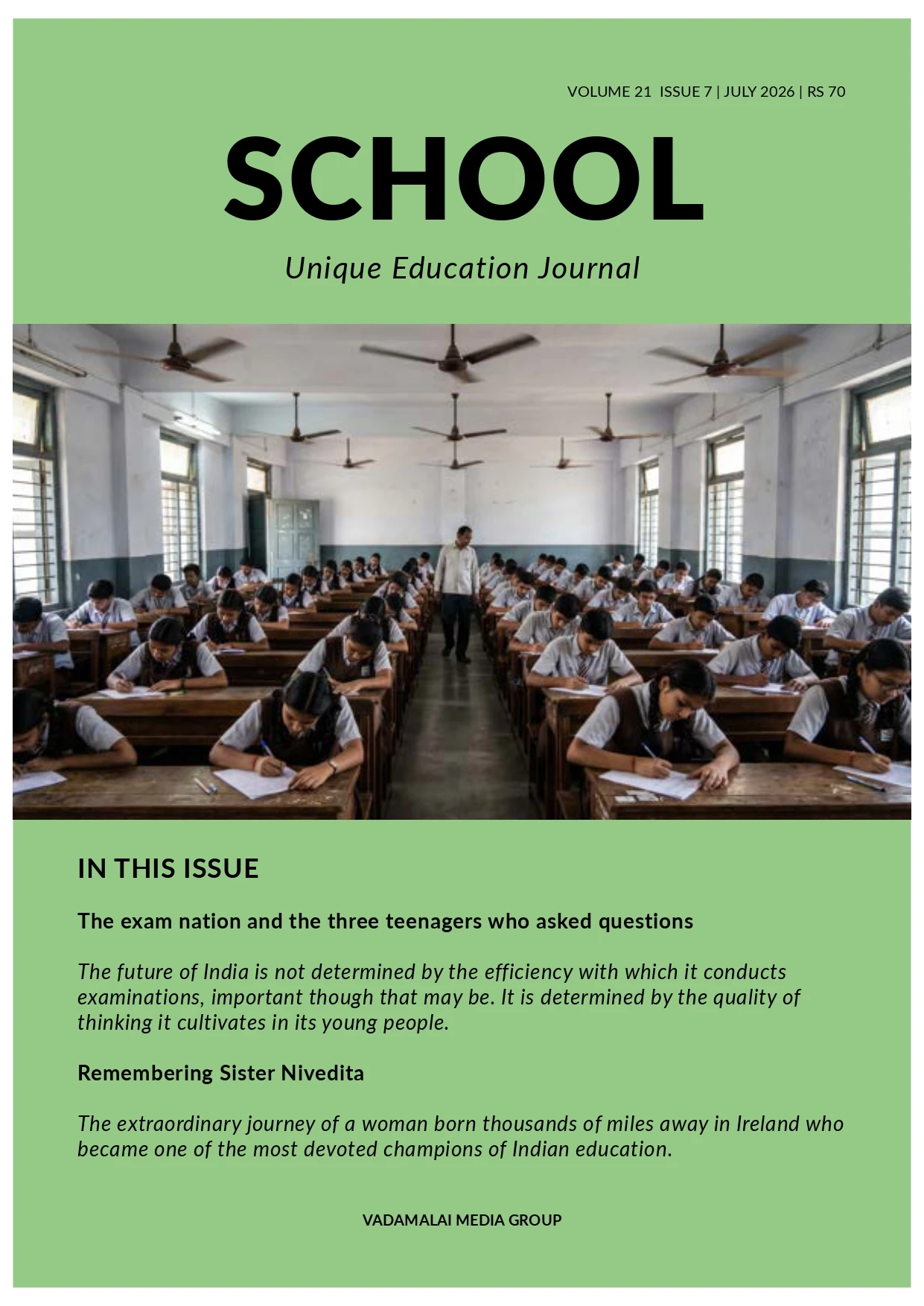
Editorial: The exam nation and the three teenagers who asked questions
Odisha announces free education from kindergarten to postgraduate level
India’s schools have reached most children, but quality remains a challenge
New SMC guidelines 2026 ask whether stronger rules can finally make school management committees matter
Debate over whether experienced teachers should be tested again under India’s TET requirement
U.S. state considers whether AI training should become mandatory for teachers
England’s teacher shortage offers a warning on why fewer people are choosing to teach
Research highlights why half of college students feel lonely and what schools can learn from it
Ekta Abrol on where good planning meets great teaching
Seema Darji on making learning joyful and exciting
Dr Madhuri Gour on joyful learning beyond grammar rules
Nandini Ghosh on a journey powered by education
Remembering Sister Nivedita, the Irish educator who helped awaken India’s educational soul
Editorial: Why India needs more teacher exchange programmes
Andhra Pradesh sends government school teachers to Singapore for specialised training
Maharashtra launches programme to send students to NASA and ISRO
Rajasthan orders government schools to publicly display teacher details
Karnataka schools to introduce daily newspaper reading for students
Growth of IB schools in India sparks debate on access and relevance
UCL research finds high-achieving mathematics students benefit from ability grouping
Harvard research explores why teachers choose to remain in the profession
Sumita Gupta on nurturing real-world thinking
Akhila K R on mathematics in everyday life and learning
Sinchan Mishra on managing the screen time problem
Dolly Ratnani on the invisible curriculum in schools
Prashant Gupta on building smarter classrooms
Remembering Savitribai Phule, the mother of modern education in India
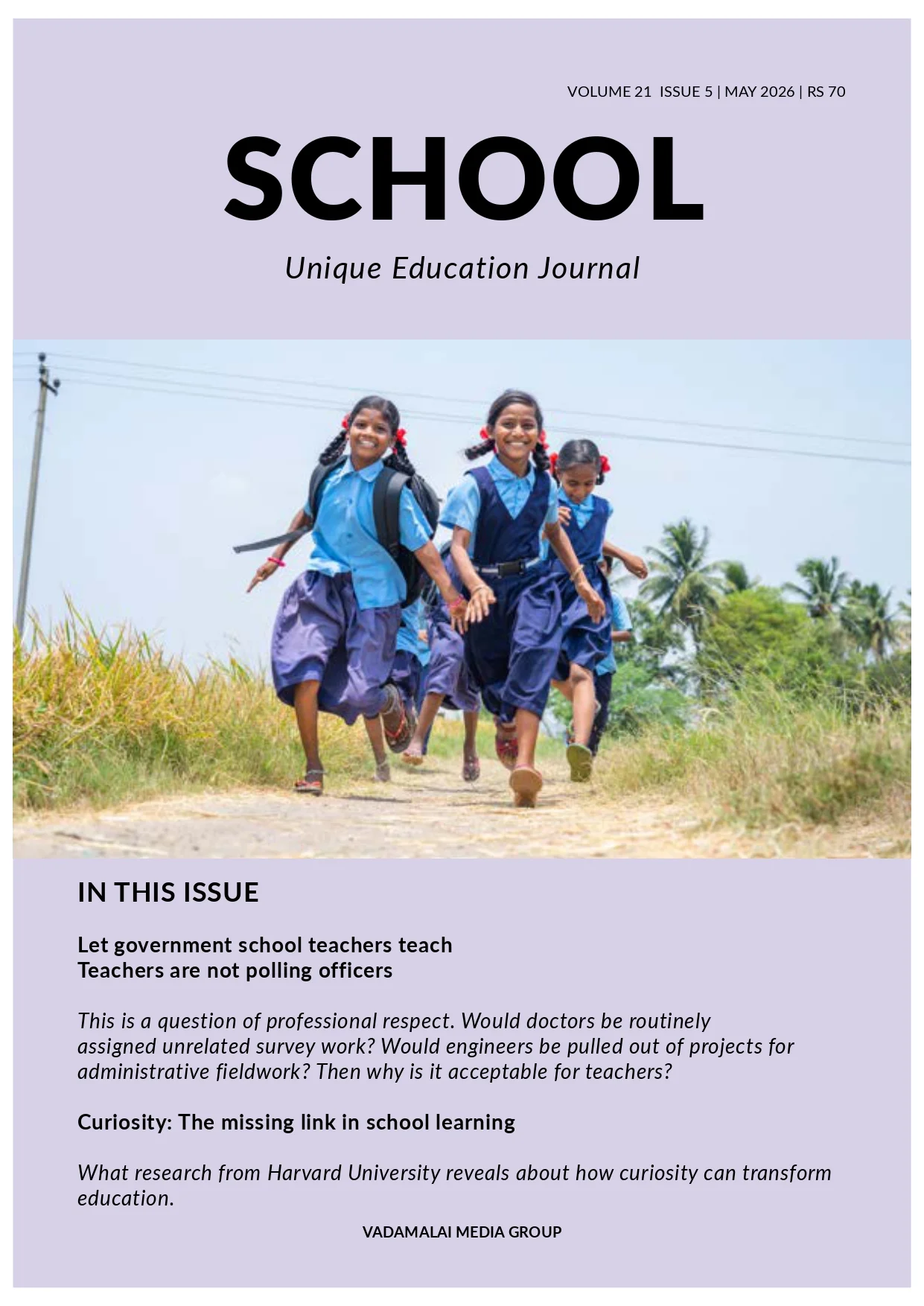
Teachers, not polling officers. Let Government School Teachers Teach
The editorial raises an important question about the growing burden of non-teaching duties placed on government school teachers. Election work, BLO duties, surveys, and administrative tasks often pull teachers away from classrooms, disrupting learning and affecting students who need stability the most. The piece argues that teachers must be allowed to focus on teaching and that this is also a matter of professional respect.
D. Gnana Soundari – Helping Students Speak English Confidently
Why language learning should focus on building confidence rather than fear of mistakes. Students learn best when teachers encourage them to express themselves freely and communicate without hesitation.
Bhavika Budhiraja – Start Strong: Capture Student Attention Early
How “hook activities” at the beginning of lessons can spark curiosity, increase engagement, and help students become more interested and attentive in the classroom.
Neetu Singh – Speaking Confidence is the Key
Why communication skills are essential for students. Confident speaking helps children understand others better, express ideas clearly, and participate more actively in learning.
Shaik Zia Ur Rehman – Careful Approach to Teaching Swimming in Schools
An important discussion on school swimming education and why survival skills, safety, and gradual learning should be prioritised over quick performance-based outcomes.
Shubhangi Raajput – NLP: A Tool for Better Teaching
How Neuro-Linguistic Programming (NLP) techniques can help teachers better understand student behaviour, improve classroom communication, and create more positive learning environments.
Education Research – Curiosity: The Missing Link in School Learning
What research from Harvard University reveals about the role of curiosity in education. The article explores how curiosity improves engagement, memory, motivation, and deeper learning among students.
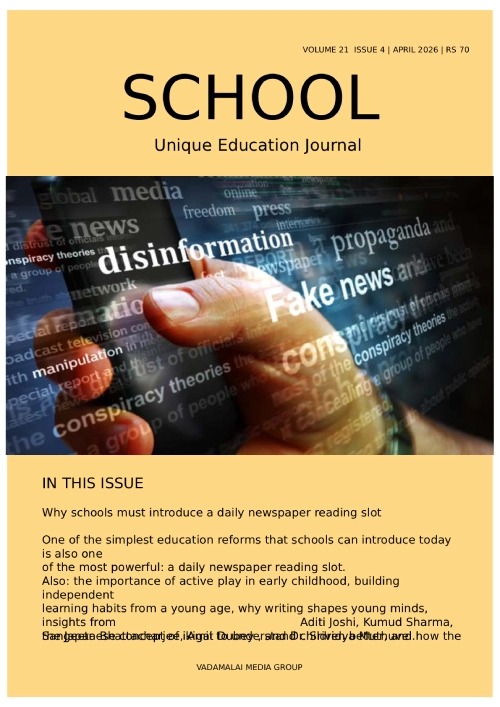
Why Schools Must Introduce a Daily Newspaper Reading Slot
The editorial explores one of the simplest yet most effective school reforms: a dedicated daily newspaper reading session. Regular newspaper reading helps students build reading habits, improve comprehension, connect learning with real-world events, and develop critical thinking and media literacy.
Aditi Joshi – Active Play and Early Childhood Learning
How young children learn best when they are free to move, explore, and play. Active play is not separate from learning—it is one of its strongest foundations.
Kumud Sharma – Encouraging Independent Learning from a Young
AgeWhy supporting independent learning early helps children become more confident, responsible, and curious learners.
Sangeeta Bhattacharjee – Why Writing Matters for Young Minds
How writing helps children organise thoughts, strengthen communication, and build clarity of expression from an early age.
Amit Dubey – Ikigai: Understanding Children Better
How the Japanese concept of Ikigai helps teachers and parents understand each child’s natural strengths, interests, and sense of purpose.
Dr. Srividya Muthuvel – How Our Brain Learns and Grows Daily
An insightful look at how the brain learns, remembers, and develops new skills every day.
How Schools Can Introduce Effective Newspaper Reading Classes
A practical guide for schools to introduce structured newspaper reading sessions in a simple, engaging, and sustainable way.

When Government Schools Empty Out, India Pays the Price
The editorial argues that declining enrolment in government schools is not a verdict, but a warning—and a critical opportunity for reform.
Who Educates India?
A deeper look beyond headlines to understand what enrollment data really says about the role and future of government schools.
Priyanka Jain – Teaching Based on How Adolescents Think
An exploration of how aligning teaching methods with adolescent thinking patterns can improve engagement and learning outcomes.
Meenakshi Pandey – Mentor Programs in Schools
Meenakshi Pandey – Mentor Programs in Schools
Dr. Sangita Thakur – Inclusion in Education
A call to move beyond token compliance towards meaningful inclusion, with practical strategies for schools to create accessible environments.
Anita Anil Gupta – The Problem with Excessive Guidance
A reflection on how over-guiding children can limit creativity, independence, and problem-solving ability.
Sapna Bhatia – Helping Second Language Learners Speak Confidently
Insights into why speaking is often the hardest skill for learners and how teachers can build confidence effectively.
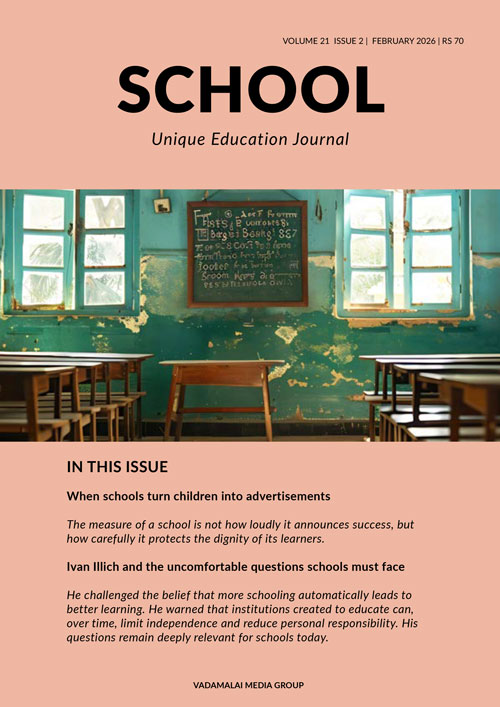
Editorial: When Schools Turn Children into Advertisements
A reflection on how public display of examination “toppers” can shift recognition into marketing — and why schools must protect student dignity over institutional image.
Why Government Schools Have Space but Not Students
An analysis of declining enrolment in government schools and what it signals about trust, quality, and the future of public education in India.
Malavika Jayakumar – How Home Environment Shapes Learning
An exploration of how family context, support systems, and emotional climate influence student outcomes.
Aditi Biswas – Maintaining Mental and Physical Health Online
Practical reflections on digital habits, boundaries, and balanced well-being.
Rakesh Kumar Kabra – How Technology Is Changing Education
A grounded look at how digital tools are reshaping teaching and learning practices.
Smriti Agarwal – How to Make Children Think Clearly
Strategies for developing clarity, reasoning, and thoughtful decision-making in students.
Srionka Samanta – Language Labs and Their Use
A practical examination of how language labs can strengthen communication skills when implemented effectively.
Ivan Illich and the Uncomfortable Questions Schools Must Face
A reflection on Illich’s warning that institutions created to serve human needs can gradually begin to shape and limit them — and why his critique remains relevant today.
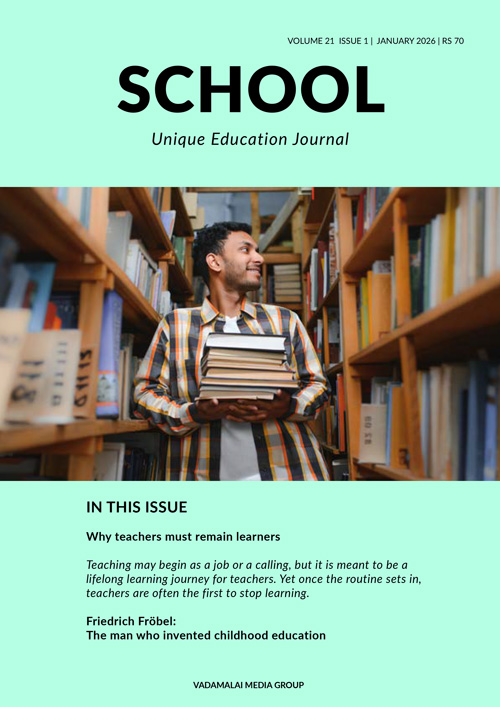
Editorial: Why teachers must remain learners
Learning time: a simple reform schools can implement
What It Means to Be a Passionate Teacher
Aruna K. Srikanth describes a passionate teacher as one who nurtures curiosity and celebrates every child’s progress, creating a classroom where students feel safe to try, fail, and grow.
Storytelling That Strengthens Learning and Relationships
Nirban Roy explains how storytelling makes lessons more engaging and relatable, helping students connect emotionally with ideas and deepen understanding.
Creative Ways for Student Assessment
Rezuan Chowdhury shows how assessment, when used thoughtfully, supports reflection and learning rather than merely measuring performance.
Excess Burden of the School Curriculum
Sireesha Prasad examines how increasingly heavy curricula place pressure on students and raises questions about depth, purpose, and meaningful learning.
How We Learn to Handle Change
Veena Keni discusses adaptability and why the ability to respond effectively to change is essential for learning, growth, and well-being.
Teaching Gen Z
Yashvi Parwani Vaswani reflects on teaching strategies suited to Gen Z learners who grow up immersed in technology from an early age.
Friedrich Fröbel: The Man Who Invented Childhood Education
A reflection on Friedrich Fröbel’s belief that play, activity, and self-expression are central to early childhood education.