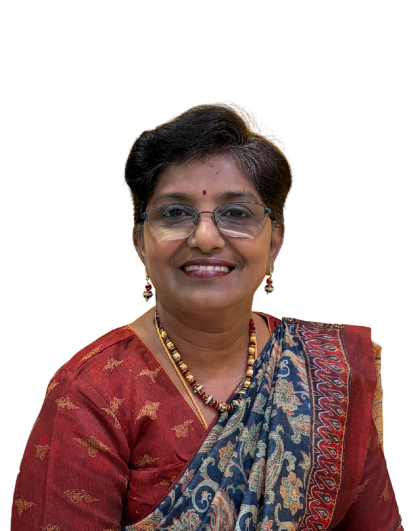
Muthulakshmi Konar, Home tutor in Navi Mumbai, explains how one can learn simple ways to stay calm and focused when pressure starts to build.
When you sit down to study and open your books for exams, what’s really going on in your mind? What are you actually thinking about? Is your mind focused on the page in front of you, or somewhere else? Are you worrying about grades you haven’t got yet? Or comparing yourself to your classmates? Replaying all those moments over and over? Today, we’re not going to talk about study techniques or schedules. We’re just going to focus on something way more basic. The difference between being present and being stressed out. 75% of students experience exam anxiety that directly affects their performance. That means if there are 30 students in this class, nearly 20 of them are dealing with exam anxiety. And you’re definitely not alone. One more thing I’d like to share with you: an average student checks their phone about 150 times a day during study sessions. Each time you do that, even if it’s just for a few minutes, you’re pulling yourself away from the present moment. Here’s what happens to your brain when you do that: when stress levels spike, your prefrontal cortex, the part responsible for reasoning, memory recall, focus, and problem-solving, basically shuts down. Your brain literally can’t access what you’ve studied when you’re overwhelmed by fear. It’s not about more or less initiation; it’s about presence. Let’s talk about how you can actually do that.
Focus without fear
This is the story of Eklavya from the Mahabharata. It’s about a student who had no teacher, no coaching classes, no textbooks. He approached Dronacharya, the greatest guru of that time, but was actually rejected because Dronacharya said he wasn’t worthy. He had to give up. I mean, if you and I had been there, we probably would have quit. But he didn’t. He had every reason to quit, but instead, he went into the forest and made a statue of the guru. He was a top student of Dronacharya and practised every day with complete focus, no distractions, no comparisons, no fear of results. Just the arrow and the moment. That’s how he became one of the greatest archers of his time. His full focus was complete attention right then and there: no comparing himself to others, no fear, no worrying about future outcomes, just the next arrow, the next moment. He didn’t have better resources, but he had a better presence of mind, and that’s something anyone can have, even now during exams when students face pressure of all kinds. These thoughts pull me away from the present. The first pull is the past. I wasted my time.
Procrastinating thoughts such as “I should’ve started earlier. Last year I failed at all these things; it feels so urgent” should be totally avoided. They can’t be changed. They only exist to steal your attention from what really matters. And the second pull is your future. What if I blank out? What will my parents think? My career will be over and all that stuff. But these thoughts aren’t real either. The exam doesn’t live in the past or the future; it lives right here, in the present, this moment, this idea, this breath. And right now. The Bhagavad Gita perfectly tells us that you have the right to act, but don’t obsess over the outcome. Do the work fully and completely in the moment and let the results take care of themselves. So how do we do that? But before that, what comes in is anxiety.
Listening to the body
Now anxiety comes in like one big wave. It speaks to you in three specific ways. You need to learn to recognise them and stop being controlled by them. The first voice is your body. Your heart pounds, your palms sweat, your mind goes blank. And here’s what I want you to know: it’s trying to protect you. It’s your survival response. Your job isn’t to push that energy away or fight it. The second one is your breath. Short, shallow breaths tell your nervous system there’s danger. Long, slow exhales do the exact opposite. They tell your system you’re safe. I’m here. You always have access to your breath. And the third voice is your thought: “What if I forget everything? Others are better prepared.” Here’s another practice name for that thought: don’t become it. There’s a beautiful concept from the Mandukya Upanishad. Be a calm witness, which means being aware that you are your consciousness. You’re not your anxious thoughts. You are the awareness watching those thoughts rise and pass. So next time panic hits during an exam, instead of saying “I’m terrified,” just try noticing the fear arising like, “I’m here; I choose to focus.” That one shift changes everything. So let’s change the mindset.
Anchoring in the moment
So, before the exam, the tool I’d love to mention is the 4-7-8 breath. It’s from an ancient pranayama technique that you do before going in. You inhale for 4 counts, hold your breath for 7, and exhale for 8. Do it twice before you enter the hall. It instantly resets your nervous system. The second one is what I call the five-second anchor. Use it whenever your mind starts to wander. And there you are during your exam. Feel your feet on the floor. Feel the pen in your hand. Five senses, five seconds, and your back. And the third question you need to ask yourself after every exam: Did I show up fully in this? Did I give what I had? If the answer is yes, you have succeeded. Marks are the outcome. Presence is the performance. Judge yourself by what you actually control. I’d like to share another story here from the Katha Upanishad.
It’s a story about Nachiketa. He was a young student. He sat alone in the realm of Yama, the god of death himself. He sat at his door for three days without food, without water, and without fear. And finally, when Yama came to meet him, he offered him everything—gold, kingdoms, pleasures—but Nachiketa refused. He said, “I only want one thing: the truth about the self.” And he got it, not because he was a talented student, but because he was more present. The Katha Upanishad teaches us to rise, wake up, and keep going until you reach your goal. Your exam hall is your Kurukshetra. It’s not comfortable at all. It’s not easy. It’s actually where your presence is tested and where you can truly shine. Before your exam time. Ask yourself honestly—am I studying out of fear and stress, constantly comparing myself? Or am I studying with full presence? Stay focused, taking it one step at a time. The answer lies beyond any chapter you’ll review twice. I’ll leave you with four reminders—read them slowly. Eklavya had no teacher, yet he mastered everything. Guru Arjun had every reason to quit, but presence made him a warrior. Nachiketa faced death calmly because of his presence. Presence gave him wisdom. And you, my dear friends, you have the question paper. Presence will give you all your answers. Remember, your marks don’t define your worth. Being present in the moment is where your power lies. The exam isn’t the battle; it’s your mind that is. And just like Arjun chose to be here, breathe and ground yourself in this moment. Focus on one question at a time. Start when you’re ready, right now.
Ancient lessons, modern minds
To be very frank, I’ve been both; I’ve heard the story since. From my childhood, from my father, I’ve been hearing that. So over time, I realised that if kids today hardly know our history, culture, and roots, then—as I introduced myself as an educator—I found that kids don’t really get it. They don’t know the history or their own culture. That’s when I started with the modern stuff because kids aren’t going to listen if you just talk about kings or old events. That stuff didn’t work on its own. But when you combine both—the history and the modern stuff—that’s what worked for me as an educator. I’m an educator teaching my classes, and I thought this was the best thing. I can use my knowledge, be tech-savvy, use modern equipment and technology, and give the best to the students- what they actually need.
Making space for calm
Because honestly, as an educator, I get stressed even more than the students. That’s one reason. And what I’ve seen happening, as I mentioned in the slides, is that kids go blank even after doing all the revision. Twice, thrice. It’s not that they’re not capable or that they haven’t tried or wasted their time. None of that. But still, kids go blank. That’s when I realise the stress levels are going high, even with the kids, forget the teachers themselves. Even with the kids. So that’s why I thought this was the perfect time, especially with the exam season going on, to talk about this topic. After applying, I had this student I’d like to talk about. Her name was Janvi.
There’s actually no age limit; it’s just that pranayama is part of yoga. In that breathing exercise, you start breathing as soon as you’re here on Earth. So, breathing exercises are fine for younger kids. I wouldn’t ask them to hold their breath if they can do it well — and that’s totally okay, no pressure. But for teenagers, starting around fifth to seventh grade, and I’d say even primary students could manage it too, they might be able to do it right. Maybe they can take a long, deep breath. Yeah, long, yes, and obviously you need the teacher if it happens in school; that’s the best, I will say. And as it is, we’re including yoga sessions in our curriculum, so I think that should help a lot. But as a parent, I mean, I’d suggest that parents should be there. That’s what I mentioned in today’s talk. It’s not just for the students; it’s for everyone. Here I am. Mainly focused on the students, but having a presence for us is important too, actually. Even as a teacher, having parents involved is the most important thing. That’s what I’d suggest. I mean, let the child have the freedom and liberty to do it on their own. And you need to believe in the child. Absolutely. No pressure.
Contact details
Muthulakshmi Konar,
Home tutor in Navi Mumbai
M: 8767359010
E: konar.muthulaksmi@gmail.com