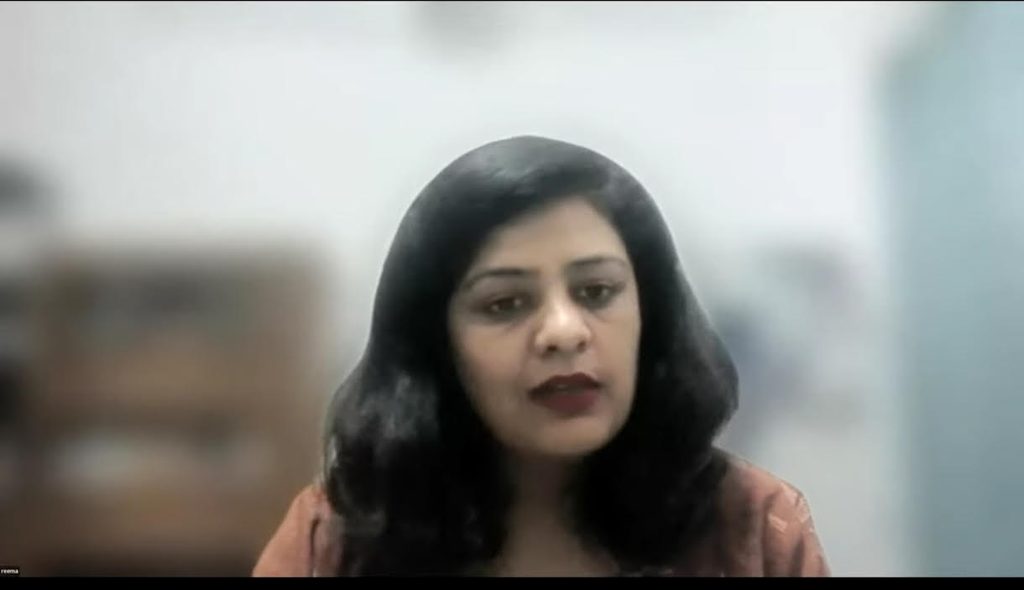
Reema Maggo Verma, Head, Mathematics Department at a CBSE-affiliated school in Ambala, Haryana, explains how using questions helps students understand and find greater meaning in mathematics.
I have a circle from which we can derive many things. Just have a look at this amazing circle. What do you see in this circle? If you add up any two of the numbers, you can see that they add up to a square number. 15 + 1 is 16. 21 + 4 is 25. 19 + 30 is 49. 24 + 25 is again 49. Then 18 + 7 is 25. So there is beauty in this circle. All the numbers have been set up in such a way that they add up to a square number. There are a few resolutions we, educators, have to work on to get our students on track to learn mathematics effectively.
Resolutions before you calculate
As a teacher, the first resolution that I would like my students to take up is that I will think before I calculate. As a teacher, we have seen that what do our students do? They look at the question, read it, and just start calculating. But we, as teachers, have to inculcate the habit of thinking before calculating, the habit of strategising before starting with the question. So this is the first resolution, the math resolution, that we would like our students to work on: strategising before they start working on the sums.
Then the second one is: I will ask why, not just what. Why is a very important word that everyone must ask before doing anything, and in mathematics it is a must because it is the very foundation of logical thinking. So, as teachers, we take it upon ourselves that we are going to develop this in our students, and how are we going to do it? By asking ourselves why.
Next is: I will show my thinking. Some of our students are very good at mathematics. They can do mathematics in their heads. They have very good metacognitive skills. But when it comes to showing their thinking, to showing what they have thought in their mind, that takes a backseat. So, as teachers, we have to develop this skill in our students, and this will only happen if students take up this resolution for the year 2026 that, yes, I am going to show my thinking in a proper manner so that everybody comes to know what I thought.
Next, I will try to solve it in more than one way. Now this is very important, but how will this come up in our students? Only by asking good questions. When we, as teachers, ask questions that can be solved in more than one way, then only the students will have this in their minds: they have to try the questions in multiple ways. Solving a question in one way happens only when we, as teachers, ask them closed questions like the question: Is the number 225 divisible by 5? The answer is yes or no. No thinking is involved, and there is no other way to solve it. So asking good questions will pave the way for this particular math.
Oh, those dreadful mistakes. I keep telling my child, ” Do not make this mistake. Be careful. You should not make this mistake.” We have to accept our students’ mistakes. Only then will they learn from their mistakes. So, as a teacher, I would show up in my class with a poster showing my favourite mistake. That would encourage students; it would not make them fearful of their mistakes. Rather, they would start learning from their mistakes, which is so important.
Let understanding take time.
Next is what happens in our classrooms. The teacher asks a question. Students raise their hands. We choose a child. We ask the child a question. And if that child is not able to answer, we still sit down. We barely give them even 3 seconds of thinking time. So what are we passing on to the child? We are telling them that understanding is not important. Speed is important. So a child will only choose understanding over speed if we, as teachers, give them more thinking time, so that they are able to understand even if they are slow in understanding. Slow math is not bad. Slow math is good math because it makes us see the patterns, the beauty of mathematics. So the last math resolution for 2026 would be that I will choose understanding over speed.
It says to write a five-digit number that is divisible by three as well as five. Now, as a teacher, you can think, but how much mathematical thinking will go on in this question? Instead of asking direct questions, we are asking a question that would give you, if you have a class of 40, 40 different answers, and the class would be so engaging. The children will be so happy because everyone gets a chance to answer. So this is the kind of questions that we are looking at, not the direct questions that we have been asking in our classrooms.
Right now, the reality is that we are asking questions that are repetitive, predictable, and that focus only on the answers and have limited thinking. Such questions are not going to give us the outcomes that we desire, and your classes will be boring and not engaging. So try to ask questions that are more engaging and more thinking-based. We are going to make the shift from focusing on answer-based questions to thinking.
Slow down, see more
Then ditch the speed in your head. Just leave it. Math is not about speed. It’s about understanding and reasoning. And slow math is not bad. Instead of asking students to solve a particular question in only one way, we should encourage them to answer the questions in many ways. This can happen if we have a discussion in the class. After we ask a good question that has multiple answers, we can have a discussion in the class. And when students come up with different ways of solving the same problem, they can see so many patterns and the beauty of mathematics.
Build number sense
Now look at this question, which says Think of two numbers that have an LCM equal to 36. Instead of giving students two numbers and asking them for the LCM, we are going to ask this question because it makes them think of the numbers. In the process, when they are thinking of two numbers and finding out the LCM, they are getting practice; they are also getting a hold of number sense, which is so important in mathematics.
Now students might come up with answers 9 and 4 and give up the LCM as 36. Randomly, they would be looking for the numbers that give an LCM of 36. So your whole class is engaged. They are looking for the numbers that give an LCM of 36. Then, gradually, as a teacher, you can make a list of the numbers. 1 and 36 give the LCM of 36. 2 and 36. 3 and 36. 4 and 36. 6 and 36. Then we have 9 and 36. 12 and 36. 18 and 36.
Now, after making this list, you can ask your children what you observe. When you ask this, you are telling them a very important concept of LCM: that the first number is a factor of the second number. Here, the first number is a factor of the second number. So the LCM is going to be the second number. You can make them apply it by asking them a set of problems like 7 and 49. What is the LCM? Straight away, they will say the LCM is 49. Then 12 and 48. What is the LCM? LCM is 48. Why? Because 12 is a factor of 48. 7 is a factor of 49. Then the next set was 9 and 4. What kind of numbers are these? These are co-prime numbers. So they also give us the LCM of 36.
By asking one simple question, by asking the way we ask questions in our class, we are paving the way for such great mathematical thinking, and we are not just telling them the answers; we are making them find the things on their own.
Learning through wrong turns
Now we have the next question, which is that we have a set of numbers, and we are asking which of these is an even number. 22, 30, 44, and 18 are the even numbers. Then, for multiples of four, they can find the number. This one is easy. Prime numbers. Generally, students will tell you the number 91. They will say 91 and 51; they will say they are prime numbers.
Now, is 91 a prime number? It is difficult to discover whether 91 is a prime number or not for a small child because it is a product of two prime numbers. Both of these are prime numbers. For a student who knows the divisibility rules, they are not taught the divisibility rules of seven and 13 either. So it is very difficult for a child to find out whether 91 is a prime number or not. And generally, students think that numbers ending in one are prime. So this particular question is focused on the misconception that numbers ending in one are prime. 51 is still easier to find because 5 + 1 is 6, and it is a multiple of 3. So this question is focusing on a non-example, a very good non-example of prime numbers, which is 91. That is what makes it a good question to ask in your math class.
Think, create, discover together.
It says to draw a shape using nine unit squares. Now, this one square is a unit square. A unit square means all sides are one unit. Now we have to draw a shape using nine of them that has a perimeter length. Perimeter is the boundary of the shape, the length of the boundary of the shape. So first we have to use it in such a way that the perimeter is as small as possible. So when we keep the nine squares like this, we get the smallest perimeter.
Now the students will collaborate, think, guess, draw so many shapes, and then come up with this answer. So much thinking is involved. Instead of asking a direct question of what the area is or what the perimeter of a given shape is, we are asking them this question, which goes up to the creation level of Bloom’s taxonomy, where the children are creating the shape on their own.
For example, Joyce had a piece of ribbon that was 64 cm long. She wanted to cut the ribbon into shorter pieces, each measuring 8 cm. How many cuts must she make on the ribbon? Now, as adults, what are we going to do? We are simply going to divide this by eight, and we’ll say eight cuts. But that’s not the case.
Let’s see: when we have a wooden piece, say I want to make three pieces. So how many cuts will I make? Only two cuts. For three pieces, I will make two cuts. Say I want to make four pieces. So how many cuts will I make? Three cuts. So for eight pieces, how many will you make? The number of cuts will be seven. So this is also a question where students are thinking and thinking in patterns.
Questions can transform the classroom.
So now what is the big idea of this presentation? The questions that we are asking in our classes are not just for checking whether the student is able to answer. We want them to think so that thinking develops, and if we change our questions, we can change our classrooms.
A very important teacher move here is that we, as teachers, must first ask, pause, and wait. Asking means that we are going to ask good questions that involve good thinking, many approaches, and everything. Then we have to pause because thinking needs time, and when we ask a good question, silence is equivalent to thinking. So this is a very important move that the teacher must take.
Contact details
Reema Maggo Verma
Head of the Mathematics Department at a CBSE-affiliated school in Ambala, Haryana
E: reemamath123@gmail.com